Extracts from the original text of Orlikowski.
Materiality, on this view, is a special case, and this is problematic because it loses sight of how every organizational practice is always bound with materiality. Materiality is not an incidental or intermittent aspect of organizational life; it is integral to it.
The other difficulty associated with organizational studies of technology adoption, diffusion, and use is their tendency to focus either on technology effects (a techno-centric perspective) or on interactions with technology (a human-centered perspective). Both perspectives are limited and limiting for a number of reasons. The techno-centric perspective is interested in understanding how technology leverages human action, taking a largely functional or instrumental approach that tends to assume unproblematically that technology is largely exogenous, homogeneous, predictable, and stable, performing as intended and designed across time and place. Yet, as critics have pointed out, this perspective reifies technology, ignores how technology is bound up with historical and cultural influences, and thus produces technologically deterministic claims about the relationship of technology with organizations (Barley 1988; Kling 1991; Suchman 1994; Thomas 1994).
The human-centered perspective focuses on how humans make sense of and interact with technology in various circumstances. Here the technology is not black-boxed but understood to be different based on the different meanings assigned to it and the different ways in which people engage with it. Furthermore, such interpretations, interests, and interactions are seen to vary by time and place, entailing a more dynamic and situated view of the relationship of technology with organizations. While this grounds use of technology in particular socio-cultural and historical contexts, it tends to minimize the role of the technology itself. By focusing primarily on the human side of the relationship, the technology — as commentators such as Button (1993) and Berg (1997) have argued — vanishes from view in the preoccupation with the social.
[A]n alternative view asserts that materiality is integral to organizing, positing that the social and the material are constitutively entangled in everyday life. A position of constitutive entanglement does not privilege either humans or technology (in one-way interactions), nor does it link them through a form of mutual reciprocation (in two-way interactions). Instead, the social and the material are considered to be inextricably related — there is no social that is not also material, and no material that is not also social.
Towards a view of Constitutive Entanglement:
to figure out how to take seriously the recursive intertwining of humans and technology in practice.
A number of particularly interesting ideas for doing so have been emerging in sociology and science and technology studies over the past decade: for example, actor-networks (Callon 1986; Latour 1992, 2005), sociotechnical ensemble (Bijker 1995), mangle of practice (Pickering 1995), object-centered sociality (Knorr Cetina 1997), relational materiality (Law 2004), and material sociology (Beunza et al. 2006).
Latour (1987, 1992, 2005) has long argued that agency is not an essence that inheres in humans, but a capacity realized through the associations of actors (whether human or nonhuman), and thus relational, emergent, and shifting.
Suchman (2007: 261) similarly emphasizes the importance of reconceiving ‘capacities for action … on foundations quite different from those of a humanist preoccupation with the individual actor living in a world of separate things’.
In particular, this requires replacing the idea of materiality as ‘pre-formed substances’ with that of ‘performed relations’, in order to characterize the recursive intertwining of the social and material as these emerge in ongoing, situated practice (Pickering 1995; Latour 2005). As Pels et al. (2002: 2) observe: ‘it is not so much what materials … symbolize within social action that matters but their constitutive agentic effects within the entangled networks of sociality/materiality’.
>>>>>
The notion of constitutive entanglement departs from that of mutual or reciprocal interaction common in a number of dynamic social theories. Notions of mutuality or reciprocity presume the influence of distinct interacting entities on each other, but presuppose some a priori independence of these entities from each other. Thus, for example, we have tended to speak of humans and technology as mutually shaping each other, recognizing that each is changed by its interaction with the other, but maintaining, nevertheless, their ontological separation. In contrast, the notion of constitutive entanglement presumes that there are no independently existing entities with inherent characteristics (Barad 2003: 816). Humans are constituted through relations of materiality — bodies, clothes, food, devices, tools, which, in turn, are produced through human practices. The distinction of humans and artifacts, on this view, is analytical only; these entities relationally entail or enact each other in practice.
‘This is a thoroughgoing relational materiality. Materials – and so realities – are treated as relational products. They do not exist in and of themselves.’ (Law, 2004:42)
>>>>>
Instead, seeing organizational practices as ‘sociomaterial’ — to borrow a term given recent currency by scholars such as Mol (2002) and Suchman (2007) — allows us to explicitly signify, through our language, the constitutive entanglement of the social and the material in everyday organizational life.
>>> Google Search and Blackberry usage examples.!!! <<<
Law and Urry (2004) argue that contemporary social science is ill-equipped to address issues of ephemerality, multiplicity, dispersion and mobility.
Ephemerality: phenomena that are ‘here today and gone tomorrow, only to reappear the day after tomorrow’. search results of google...
Multiplicity: that which takes different shapes in different places’. results are multiple and shifting acc to conditions and contexts.
Dispersion and mobility: the distribution and movement of ideas across time and space may be manifest in many ways.
to forgo perspectives that treat materiality as either invisible or inevitable, or that abstract, black-box, and separate technology from human affairs. Instead, we need perspectives that are grounded in ontological and epistemological sensibilities that take seriously the sociomateriality of organizing.
Material sociology and science and technology studies offer useful vocabularies and guidelines for exploring the deep intermingling of materiality within practice. These can help us reconfigure our taken-for-granted notions, assumptions, and practices of organizational research, and allow us to recognize and investigate the multiple, emergent, and shifting sociomaterial assemblages that constitute organizations.
Showing posts with label Agency Design and Things. Show all posts
Showing posts with label Agency Design and Things. Show all posts
Saturday, July 30, 2011

Saturday, July 23, 2011
Opening Spaces of Possibility - The Enactive as a Qualitative Research Approach
Extracts from the original text by Johnna Haskell, Warren Linds & John Ippolito
"The world that is enacted is inseparable from how we act in it" (VARELA et al., 1991, p.140).
This approach implies that knowing emerges collectively through engagement in shared action. Embodied action brings forth an awareness of inquiry which is not attached to any one event or concept but is, rather, an un-grounding, as knowing is shaped by our actions with/in the world. Groundlessness is an exciting "space" where possibility arises for how we think about knowledge, cognition, and experience.
If knowledge and learning are not located in a body, but in the shifting movement of experiencing, new possibilities emerge for how researchers perceive, interpret, research, and interact within the world. We cannot imagine ourselves just "operating in" research settings, and then leaving the cultures of which we are part. Nor can we ignore the ethics of research, since research is also the site of an ongoing ethical event implicating all those involved.
If we take our partiality as researchers, the fact that we always influence the direction of our work, indeed, that our work is in many ways an expression of who we are and who we are becoming, we can interact with our connection to the research not as a liability to be guarded against, but as an opportunity to make the research more meaningful by more fully appreciating our part, as researchers, in it. [2]
When one lets go of objectivity as an unattainable and constraining icon then we begin to see our connection to the research as an asset. In what ways are the researcher, the research participants, and the research setting shaping each other? Are they distinct entities, or only possible in relation? How do we understand their mutual interaction? As research? As knowing? As experiencing? [3]
They refer to the "enactive view that cognition has no ultimate foundation or ground beyond its history of embodiment" (VARELA et al., 1991, p.xx). [4]
The enactive approach is best expressed as "the growing conviction that cognition is not the representation of a pregiven world by a pregiven mind but is rather the enactment of a world and a mind on the basis of history of the variety of actions that a being in the world performs" (VARELA et al., 1991, p.9). [5]
Collective action, which can be none other than embodied action, is yet an awareness which is not attached to any one body or event or concept but is, rather, an un-grounding that VARELA, et al., refer to as "groundlessness." Groundlessness is an exciting "space" where possibility arises for how we think about knowledge, cognition, and experience. [7]
how, by engaging in our research in situated and concrete contexts, opportunities arise through shared, relational, and embodied interpretation practices. [9]
Enactive Approach:
We need to embrace the unpredictable and unexpected moments, the unfolding we are immersed with/in yet not graspable, in that they are constantly arising through action and not located in a self. If knowledge and learning are not located in the body or self but located in the shifting movement of experiencing, then this opens new possibilities for how we perceive, interpret and represent research.
Enactive inquiry is not some position, or set of questions, but a way of being "present" or open to the non-concrete. The best way to "record," relay, or interpret such spaces of inquiry is through our embodied listening, storying through photographs, and story telling or writing images (interactions) as they arise. [16]
"The role of the qualitative researcher, much like the artist/dancer's role, demands total involvement and commitment in a way that requires a total immersion of the senses in the experience. ... The researcher is connected to the participants in a most profound way, and that is how trust is established, which in turn allows for greater access to sources and which ensures an involvement on the part of participants that enables them to tell their respective stories. ...
The challenge is how to bring forth such experiencing in such a way that it continues to be enactive and not set in a step by step process.
Dewey:
"Thinking is a process of inquiry ... all thinking is research, and all research is native, original, with [whomever] carries it on, even if everyone else in the world already is sure of what [he/she] is still looking for. It also follows that all thinking involves risk. Certainty cannot be guaranteed in advance. The invasion of the unknown is of the nature of an adventure; we cannot be sure in advance" (p.148).
Theatre of the Oppressed is a popular theatre approach which proposes that knowledge emerging aesthetically through a series of theatre exercises and games is already in itself the beginning of a transformation.
My work involves enabling groups of people to create short plays together. Warmup or tune-up exercises are used to develop a sense of community and trust. These activities are also performative as they both develop, and carry, the relationship I have with participants as active sites of knowing and understanding.
"What we do is what we know, and ours is but one of many possible worlds. It is not a mirroring of the world, but a laying down of the world" (VARELA, 1987, p.62). In this process the researcher/facilitator becomes an adventurer, an experimenter, and a catalyst who invites, encourages and dares exploration with others. The participant is also a researcher as, both individually and collectively, they explore through their bodies the themes that emerge.
How can such an enactive7 view assist us in creating conditions where research continually takes into account the emerging networks of relationships that continually grow, change and respond to challenges? [38] I will explore in this essay the implications for inter-subjective forms of qualitative research of how the shaping of a dramatic structure is intertwined with our play within it as knowing emerges through a variety of forms of actions which are simultaneously the medium, subject and re-presentation of research.As facilitator/researcher I am capable of occupying many positions in the work,and don't rest with any. I am continuously learning with/in the workshop environment; I am not just directing participants on what to do. Rather, I am co-implicated in an exploration process and co-evolving alongside the participants in the process. Although I am a facilitator, and they are participants, I am co-implicated with them as a participant. I must be able to shift back and forth—facilitator as participant, participant as facilitator. The work is shaped by me and Iam shaped by it in a circular process.
Judith PIPPEN (1997)'s approach. "the dynamic inter-relationship of our bodyhood and its multidimensional relational space" (p.72), which overcomes bodymind, voice/movement splits in human relationships.
How can we help others learn reflective and mindful awareness that empowers them to access their intuitive and embodied abilities, as well as fuel their interpretive and imaginative powers in their research practice?
As in this exercise, research is a dialogical and social process. Things happen spontaneously as people play and inter-play with each other, finding and filling spaces for dialogue and interaction. Can we also play with the idea that these spaces are also spaces of the possible, enlarged through our interactions?
Complicity—being implicated in/with—moves us as researchers from managing a simplistic system of designed input-outcome-based inquiry towards one of dynamic engagement and interaction. This requires an attentiveness to our participation through events, engaging in knowingbeingdoing in a complex and forever unfolding world.
Fritjhof CAPRA's (1998) contrast of designed structures with emergent ones. Designed structures are formal structures and content, while emergent ones are the informal network of relationships that "continually grows, changes, and adapts to new situations" (p.47). An emergent structure incorporates a different form of relationship than that of a designed structure. Whereas a designed structure is based on rules and procedures, an emergent one facilitates the continual emergence of new structures by encouraging questioning and rewarding innovation. This fits in more with the idea of complicity which I have outlined whereby facilitating emergence requires us to pay attention to how the system operates in order to continually create conditions for it to flourish.
Research informed by and respectful of the complex worlds of these settings are not just "interventions" but instances of complicity whereby our research unfolds with communities-in-the-making through partnerships and interrelationships.
Thus, research means becoming attuned to such complicity, to be able to improvise within it and to realize that control doesn't reside with the researcher all the time, but is distributed amongst the participants from moment to moment. We have a responsibility to embody awareness of the intentions, values and beliefs emerging through such partnerships.
Creating the conditions for interactive inquiry in this light means that research is not the "finding" of some passive knowledge, preconceived, believed to be known in advance, "believed to be (exclusively) a given" (FELMAN, 1995, p.56). Research then becomes an "open space through which thing-flows are distributed rather than plotting out a close space for linear and solid things" (DELEUZE & GUATTARI, 1988, p.361). Such spaces are always emerging, but we must be aware of them when they do, attending "closely to my nonverbal experiences of the shifting landscape that surrounds me" (ABRAM, 1996, pp.59-60). [
I offer suggestions for actions as I guide the group. Not only do these actions bring forth an awareness of feelings in the group, they also bring me into contact with my own senses as the ripples of group action echo back to me.
Our research method is intertwined with the content of our research. This is a phenomenological approach to research method, not as a series of steps but one where I must listen (in an embodied way) to the content or focus of my research and the appropriate method will emerge through my interaction with the research I engage in. Isn't the traditional approach that your research question determines your method. I think what we are suggesting is a much more interactive and holistic process.
Our research method is intertwined with the content of our research. This is a phenomenological approach to research method, not as a series of steps but one where I must listen (in an embodied way) to the content or focus of my research and the appropriate method will emerge through my interaction with the research I engage in. Isn't the traditional approach that your research question determines your method. I think what we are suggesting is a much more interactive and holistic process.
Performance theorist Peggy PHELAN explains performance as "honoring the idea that a limited number of people in a specific time/space can have an experience of value which leaves no visible trace afterwards"
So, rather than having the research question determine the method, my interaction with teachers and students informs my approach and specifies my direction.
This brings us back to the origins of the word research. One root of the French word (rechercher) is the old (1080) word "recerchier", meaning "parcourir en cherchant" ("to travel while searching"). Research as such a journey into knowing means, as John puts it, there are no fixed start or ending points—we are always in the middle of something.
This brings us back to the origins of the word research. One root of the French word (rechercher) is the old (1080) word "recerchier", meaning "parcourir en cherchant" ("to travel while searching"). Research as such a journey into knowing means, as John puts it, there are no fixed start or ending points—we are always in the middle of something.
Workshop 3 exercises
Extracted from Really, Really Small: The Palpability of the Invisible by Thecla Schiphorst
Augusto Boal [4] terms these types of experiential exercise de-specialization. He states that in our every day lives “the senses suffer. And we start to feel very little of what we touch, to listen to very little of what we hear, and to see very little of what we look at. We feel, listen and see according to our specialty. The adaptation is [both] atrophy and hypertrophy. In order for the body to be able to send out and receive all possible messages, it has to be reharmonized [through] exercises and games that focus on despecialization.” Boal’s goals in theatre are to create imaginative, social and political agency. His work is premised on the notion that agency at the bodily level (agency of the self) enables agency at the social and political level. Many exercises in Somatics and performance focus on this idea of retraining attention in order to increase awareness and agency through the body, and can be applied to many levels of awareness that extend beyond the personal.
By depriving the body of its external hearing it can become aware of the internal sound otherwise made invisible by the louder external sounds. We are removed from our own ears, but not from our hearing. In performance, artists like Pauline Oliveros and Augusto Boal have created practices such as “deep listening”, and “listening to what we hear”, which probe and access these very same questions of experience. The responses to the very simple question on the cards: What did you hear? focus on access to this level or resolution of experience. Responses indicated the participants’ discovery of the internal soundscape.
At the beginning of the workshop, the participants were asked to move in slow motion, as slowly as possible. They were then left to move very slowly for 10 minutes without speaking.
In Dance practices such as Butoh, this technique is utilized to enable the body to shift its attention to an immersive state in relation to its environment, what Csikszentmihalyi would term ‘flow’, where attention is intensified, and sensory details are sharpened. In neurophysiology and psychology [41] experimental studies show that the slowing or stopping of movement changes the conscious states we normally have and allows for observing the constant shifts of thought, sensation, or expands the ability to observe characteristics of basic experiencing [20].
Thursday, April 14, 2011

Saturday, March 26, 2011
Inscribing Sensitivities into Design
This is the title of my next paper. Here is the abstract:
This research aims to develop an approach to design in order to support relational nature of human capacity for action. Supporting relationality asks for a different approach or sensitivity to the ways we perform design practice. Rather than trying to control, predict or prescribe actions and relations of users, designers may design for actions more emergent and relations more fluid. Moreover, designers need to consider the performative aspects of design that require a broader notion of design process, which extends the scope of design to include design-in-use. In this broader landscape of design, designers also need to revisit their roles and the traditional boundaries between designers and users. The study follows a research through design approach and synthesizes various perspectives and approaches from feminist Science and Technology Studies, Participatory Design, Seamful Design and Actor-Network Theory. In the paper, we introduce an analysis of previous design cases and approaches that demonstrate different ways of addressing the relational character of human capacity for action. As a result of our analysis, we suggest six qualities to sensitize design: visibility, multiplicity, relationality, accountability, duality and configurability. Finally, we discuss some strategies to inscribe these qualities into design process. Our analysis involves design cases only from interaction design field, but we see a broader relevance to other design domains.
This research aims to develop an approach to design in order to support relational nature of human capacity for action. Supporting relationality asks for a different approach or sensitivity to the ways we perform design practice. Rather than trying to control, predict or prescribe actions and relations of users, designers may design for actions more emergent and relations more fluid. Moreover, designers need to consider the performative aspects of design that require a broader notion of design process, which extends the scope of design to include design-in-use. In this broader landscape of design, designers also need to revisit their roles and the traditional boundaries between designers and users. The study follows a research through design approach and synthesizes various perspectives and approaches from feminist Science and Technology Studies, Participatory Design, Seamful Design and Actor-Network Theory. In the paper, we introduce an analysis of previous design cases and approaches that demonstrate different ways of addressing the relational character of human capacity for action. As a result of our analysis, we suggest six qualities to sensitize design: visibility, multiplicity, relationality, accountability, duality and configurability. Finally, we discuss some strategies to inscribe these qualities into design process. Our analysis involves design cases only from interaction design field, but we see a broader relevance to other design domains.
Monday, March 14, 2011
Expressing and legitimating ‘actionable knowledge’ from within ‘the moment of acting’
Some extracts from the original text by John Shotter:
"In this paper I distinguish between two kinds of speech/writing: ‘withness (dialogic)’ -talk and ‘aboutness (monologic)’ -talk . Crucial in this distinction is our spontaneous, expressive, living, bodily responsiveness.While monological aboutness-talk is unresponsive to the activities of the others around us, dialogical withness-talk is not. In being spontaneously responsive both to the expressions of others, as well as our own, as I show in the paper, it engenders in us both unique anticipations as to what-next might happen along with, so to speak, ‘action-guiding advisories’ as to what-next we might do"
"To turn to Bakhtin’s (1986) contribution first: He introduces us to the idea of a previously unnoticed kind of understanding spontaneously occurring within our ongoing involvements in our ordinary, everyday, practical activities, a relationally-responsive understanding, that can contrasted with the representational- referential forms currently more familiar to us."
"It is a kind of thinking that takes place, not like geometric reasoning, in episodic moments in terms of static, spatially arrayed shapes and forms; nor in terms of measuring spatial like up against spatial like to achieve a correspondence or not. Indeed, it is a style of thought that, metaphorically, is not best described as a kind of ‘seeing’ at all. Instead, it is a style of thought that only takes place in motion, that works in terms of felt, living, inner, expressive-responsive ‘movements’ unfolding in time—above, I have called it ‘withness’- thinking to contrast it with our more usual style of ‘aboutness’-thinking."
"that when someone acts, their activity cannot be accounted as wholly their own activity—for a person’s acts are partly ‘shaped’ by the acts of all the others around them. Thus, because the overall outcome of any exchange cannot be traced back to the intentions of any of the individuals involved, the ‘dialogical reality’ or ‘space’ constructed between them is experienced as an ‘external reality’, a ‘third agency’ (an ‘it’, a ‘something’) with its own (ethical) demands and requirements: “The word is a drama in which three characters participate (it is not a duet, but a trio)” (Bakhtin 1986: 122)—in other words, it is as if this third agency, this something, has a ‘voice’ of its own to which dialogue participants must also respond. This is where all the strangeness of the dialogical begins."
"such inter-activity cannot be simply described as a sequence of actions (for it is not done by individuals; and cannot be explained by giving people’s reasons ), nor can it be simply described as behavior (as it cannot be explained in terms of causal principles either); it constitutes a distinct, third sphere of dynamically intertwined activity, sui generis , with its own distinctive properties. It involves a special kind of nonrepresentational, sensuous or embodied form of practical-moral (Bernstein 1983) understanding, which, in being constitutive of people’s social and personal identities, is prior to and determines all the other ways of knowing available to us. What is produced in such dialogical exchanges is a very complex ‘orchestration’ of not wholly reconcilable influences — as Bakhtin (1981) remarks, both ‘centripetal’ tendencies inward toward order and unity at the center, as well as ‘centrifugal’ ones outward toward diversity and difference on the borders or margins."
Their complex intertwined nature makes it very difficult for us to characterize them: they have neither a fully orderly nor a fully disorderly structure, neither a completely stable nor an easily changed organization, neither a fully subjective nor fully objective character. As a complex dynamic ‘orchestration’ of many different kinds of influences, they lack specificity, they are only partially determined: they are just as much material as mental; just as much felt as thought; in being ‘spread out’ amongst all those participating in them, they are ‘non-locatable’; they are neither ‘inside’ people, but nor are they ‘outside’ them; they are located in a ‘dialogical space’ where ‘inside’ and ‘outside’ are, seemingly paradoxically, one. Due to their living continuity, they do not allow for the spatialization of time into a sequence of events each with a separate ‘before’ and ‘after’ (Bergson), nor do they allow for separable agencies or effects; they consist only in meaningful wholes which cannot divide themselves into separable parts."
"Indeed, it is precisely their lack of any pre-determined order, and thus their openness to being specified or determined by those participating within them in practice (while usually remaining quite unaware of having done so), that is their central defining feature."
"this is precisely what makes this sphere of activity interesting to us, for at least the two following reasons: (1) to do with in situ practical investigations, i.e., action research, into how people actually do in fact manage to ‘work things out’ effectively between themselves, and the part played by the ways of talking/ writing we interweave into them in so doing; but also (2) for how we might refine and elaborate these spheres of talk intertwined activity, and how by an appropriate use of such talk, we might extend them into novel spheres as yet unknown to us."
"I began with a comparison of two styles of writing: 3rd-person reportings and 1st-person tellings, a comparison between talk/writing that leaves us ‘unmoved’ with that which ‘moves’ us. While objective, reporting-style of writing may serve an important authoritative function in setting the outside limits, so to speak, within which an institution must function. To the extent that action research has to operate within the ordinary, ongoing, everyday life activities of organizations, institutions, businesses, and all the other everyday spheres of worklife, each unique in its own way, it is the second telling-style that will give rise to actionable knowledge.While the first style attempts to capture the nature of life in another world independent of us, it is the second that enables us to enter into another world, with a life of its own, not independent of us, but in relation to us —thus to gain a sense of its movements relative to ours."
"While 3rd-person reports of research, represent important regularities and de-contextualized universals, i.e., facts, about the groups in question researched into by outsiders to the groups, 1st-person tellings work in a different way. They are related to the experiences of insiders to those groups, and they work so that in their telling they ‘move’ listeners into paying attention to previously unnoticed particularities within the ‘world’ of the insiders—and it is in this way, in making the unnoticed noticeable, that, although the cases described might seem to be utterly unique and particular, they can in their telling give rise, nonetheless, to transferrable or actionable knowledge."
"a distinction between ‘withness-‘ and ‘aboutness-thinking/talking/writing’: Withness (dialogic)- thinking is a form of reflective interaction that involves coming into living contact with an other’s living being, with their utterances, their bodily expressions, their words, their ‘works’. It gives rise, not to a ‘seeing’, for what is ‘sensed’ is invisible; nor to an interpretation, for our responses occur spontaneously and directly in our living encounters with an other’s expressions; but to a ‘shaped‘ and ‘vectored‘ sense of our moment-by-moment changing placement in our current surroundings—engendering in us both unique anticipations as to what-next might happen along with, so to speak, ‘action-guiding advisories’ as to what-next we might do.While aboutness (monologic)-thinking, however, is unresponsive to another’s expressions; it works simply in terms of a thinker’s ‘theoretical pictures’—but, even when we ‘get the picture’, we still have to interpret it, and to decide, intellectually, on a right course of action"
"While Sacks’s account works in terms of unfinished, fluid or flexible varieties of possibilities. And while he leaves it open as to how Dr P. might respond—for he issues invitations not commands—it is the relation of Dr P’s unique responses to Sacks’s invitations, that are revealing of the unique nature of Dr P.’ s ‘world’. Furthermore, in engaging us, Sacks’s style of writing is ‘moving’, we are ‘moved’ by it in the sense that provides us with a shaped and vectored sense of Dr P.’ s ‘world’, i.e., a sense of how, practically, to find out ‘way about’ within it, thus to ‘go on’ with him in practical ways that make sense to him (Wittgenstein 1953)."
"In dialogical-prospective-relational styles of writing, however, we would be talking/writing to our readers of the character of our ongoing involvements with certain other people, as if from within that involvement - while both looking back on what had been achieved so far, and forward prospectively, toward the possibilities open to us for our next ‘steps’. Our concern in such talk/writing would be with attempting to ‘show’ or ‘make manifest’ to readers (metaphorically) how they might, justifiably , be able to make sense of the character of such involvements."
"People’s sense of their own responsibility for their actions is, then, at the very basis of science itself. Scientists lacking any sense of their own participation in events occurring around them would be unable to do experiments. So, although Sacks’s style of writing may seem ‘anecdotal’, may seem to be merely about single, peculiar particularities, it is an unavoidable style of communication that all scientists must indulge in, if they are to instruct one another in how the categories of their theories should be used and applied—for the categories of such un-involving, such ‘non-moving’ forms of talk, do not apply themselves."
Saturday, March 12, 2011
Designing the technology vs Designing the design process
I need to be clear on what the next workshop series will be about.
or
how to design for relations?
exploring the ways the design process might support relationality of agency and its diversity in production and use of technologies.
Critical point: embodying agency-sensitive qualities in a successful way may not necessarily lead to have technologies that are agency-sensitive (i.e modular, open, flexible, configurable??) so do we need to add another design phase to tune the outcomes of the participatory design sessions? or should we assume that if the process involves agency-sensitive qualities, this will lead to agency-sensitive technologies, which may be in many different forms according to the cases? or may agency-sensitive products have some more general properties or may they have particular properties for every case? may be this is also part of the research...
- Is it a design/research project for developing a technology for supporting different forms of "togetherness" ? or
- Is it a design/research project for exploring designing for relational agency?
or
how to design for relations?
exploring the ways the design process might support relationality of agency and its diversity in production and use of technologies.
Critical point: embodying agency-sensitive qualities in a successful way may not necessarily lead to have technologies that are agency-sensitive (i.e modular, open, flexible, configurable??) so do we need to add another design phase to tune the outcomes of the participatory design sessions? or should we assume that if the process involves agency-sensitive qualities, this will lead to agency-sensitive technologies, which may be in many different forms according to the cases? or may agency-sensitive products have some more general properties or may they have particular properties for every case? may be this is also part of the research...
Sunday, March 6, 2011
C&C Paper
- How might a relational view of agency help fostering improvised and emergent actions, non-prescriptive ways of knowing and relating?
- Distributed cognition
- Extended mind
- ANT
- Feminist STS
- Participatory Design
- How might we design for relational agency? how might we design for relational agency in order to facilitate creativity in design and use phase?
- What might be the qualities needed for designing for agency? how might we sensitize our design process to embody those qualities? towards Agency Sensitive Design...
- What are the examples of existing projects with Agency Sensitive qualities?
- in IXD:
- Critical Technical Practice- general
- Reflective Design - leisure and museum
- Cultural Probes - inspiration
- Ludic Design - elderly
- Seamful Design- game
- Affector- leisure
- Aanestad's work- medical
- Goodwin's work- medical
- Femtedit-Educational
- more examples from Suchman, Barad, Bardzell and Corina Bath
- in Art:
- Xin Wei
- Schiphorst
- Loke
- Manning
- Jacucci
- not a total solution or absolute formula but some tuning operations in design and use!
- micro adjustments
Thursday, March 3, 2011
Materiality of Learning - Spatial Imaginaries
Some extracts from Estrid Sørensen's book Materiality of Learning
"... instead of predefining the specific ways in which humans and materials relate to one another, I analyse the particular forms of technology, knowledge and presence that are performed out of particular socio-material arrangements.The question of how parts relate to one another is an empirical question."
"a minimal methodology, which applies the theoretical technologies of imaginaries, performance and participation. I develop the notion of spatial imaginaries as a sensitivity to describing how participants relate and what spatial formation is thereby created. The spatial imaginary of a socio-material arrangement describes the pattern, landscape, or shape that is formed spatially by and through relations and the parts they connect.
It is a methodology that attempts to know as little as possible in advance.
Definitions are results, not beginnings."
"Spatial metaphors, suggested by Mol and Law (2001), help characterize the different patterns of relation in which the computer program and other materials participated in practice.
1. the metaphor of network indicates the connectedness
2. fluid, the varying character of the ways in which components are related
3. region, the grouping of elements in containers.
One particular aspect of spatial imaginaries is that they enable us to describe how one technology participates in different ways, forming different patterns of relations. "
"
Participation: is the concept that allows us to ask how material and other participants participate in practice. We should not focus on participants; instead we should follow participation, which is the way in which components take part in practice. Is the relationship between the pupil and the room really "noticing"?
Performance: allows us to ask what is achieved through an arrangement of interrelating parts, of participations. If the relationship between the boy and the room is of "noticing", we may say that through this relationship he is performed as "observer" and his knowledge of the room is performed as "impression."
Imaginary: Concepts and sensitivities are thus developed in the course of research process, not as representational knowledge about the empirical practice but as methodological concepts that embody and translate the empirical experiences. .. appreciation for the materiality of doing research
"
"... instead of predefining the specific ways in which humans and materials relate to one another, I analyse the particular forms of technology, knowledge and presence that are performed out of particular socio-material arrangements.The question of how parts relate to one another is an empirical question."
"a minimal methodology, which applies the theoretical technologies of imaginaries, performance and participation. I develop the notion of spatial imaginaries as a sensitivity to describing how participants relate and what spatial formation is thereby created. The spatial imaginary of a socio-material arrangement describes the pattern, landscape, or shape that is formed spatially by and through relations and the parts they connect.
It is a methodology that attempts to know as little as possible in advance.
Definitions are results, not beginnings."
"Spatial metaphors, suggested by Mol and Law (2001), help characterize the different patterns of relation in which the computer program and other materials participated in practice.
1. the metaphor of network indicates the connectedness
2. fluid, the varying character of the ways in which components are related
3. region, the grouping of elements in containers.
One particular aspect of spatial imaginaries is that they enable us to describe how one technology participates in different ways, forming different patterns of relations. "
"
Participation: is the concept that allows us to ask how material and other participants participate in practice. We should not focus on participants; instead we should follow participation, which is the way in which components take part in practice. Is the relationship between the pupil and the room really "noticing"?
Performance: allows us to ask what is achieved through an arrangement of interrelating parts, of participations. If the relationship between the boy and the room is of "noticing", we may say that through this relationship he is performed as "observer" and his knowledge of the room is performed as "impression."
Imaginary: Concepts and sensitivities are thus developed in the course of research process, not as representational knowledge about the empirical practice but as methodological concepts that embody and translate the empirical experiences. .. appreciation for the materiality of doing research
"
Sunday, February 6, 2011
Agency Sensitive Evaluation of Luscious Apparatus Performance Workshop
I attended to a workshop and assist Lian Loke in a research study called Luscious Apparatus at Critical Path. I'm planning to use it as a case for my research as well.
This will be an analysis and evaluation work.
I will investigate:
- How agency-sensitive design qualities are embodied or not
- How are different materialities negotiated?
-- For visibility:
visibility in design phase (visibility of processes, participants, artifacts, roles, aims, procedures), visibility targeted to be materialized n use phase (still needs to be considered in design phase, any consideration of making visible the interactions, structural elements of context, infrastructure or technological artefacts. or increasing awareness of participants towards themselves, others, artefacts or environment.)
if actants can see or perceive the environment and other actants in it (related to his interests acc to the case), this brings a possibility of creating a connection between perceiving and perceived actants. This connection is the starting point of relational agency. By means of making visible all the actants in a design case, we can facilitate the emergence of different forms of agency (i.e. each temporary assemblage with different configurations may lead to a different capacity and series of effects and we can consider them different forms of agency). it is directly related with increasing the awareness of one actant towards self, others and environment. if an actant has awareness, it can get connected.
> What to make visible? actants, artefacts, processes, roles, infrastructure (any contextual element. however, too much visibility might create confusion and may invade privacy, it should be carefully managed. for instance, peripheral or ambient awareness/visibility might be a suitable way. )
> When to make visible? visibility in production phase (for cognitive justice(initial step, more needed), for recognition of roles and contributions and for explicating possibilities of new couplings or assemblages ) and visibility in use phase (more control and care are needed for preserving privacy, but explicit interaction at some degree can still be beneficial for accountability and emergent, improvised and collective action)
> How to make visible? focus/nimbus model, SEAMs, accounts, awareness literature, public availability of resources, co(a)gents, stuvidpi, self-disclosure, infrastructure awareness systems.
-- Multiplicity:
This will be an analysis and evaluation work.
I will investigate:
- How agency-sensitive design qualities are embodied or not
- How are different materialities negotiated?
-- For visibility:
visibility in design phase (visibility of processes, participants, artifacts, roles, aims, procedures), visibility targeted to be materialized n use phase (still needs to be considered in design phase, any consideration of making visible the interactions, structural elements of context, infrastructure or technological artefacts. or increasing awareness of participants towards themselves, others, artefacts or environment.)
if actants can see or perceive the environment and other actants in it (related to his interests acc to the case), this brings a possibility of creating a connection between perceiving and perceived actants. This connection is the starting point of relational agency. By means of making visible all the actants in a design case, we can facilitate the emergence of different forms of agency (i.e. each temporary assemblage with different configurations may lead to a different capacity and series of effects and we can consider them different forms of agency). it is directly related with increasing the awareness of one actant towards self, others and environment. if an actant has awareness, it can get connected.
> What to make visible? actants, artefacts, processes, roles, infrastructure (any contextual element. however, too much visibility might create confusion and may invade privacy, it should be carefully managed. for instance, peripheral or ambient awareness/visibility might be a suitable way. )
> When to make visible? visibility in production phase (for cognitive justice(initial step, more needed), for recognition of roles and contributions and for explicating possibilities of new couplings or assemblages ) and visibility in use phase (more control and care are needed for preserving privacy, but explicit interaction at some degree can still be beneficial for accountability and emergent, improvised and collective action)
> How to make visible? focus/nimbus model, SEAMs, accounts, awareness literature, public availability of resources, co(a)gents, stuvidpi, self-disclosure, infrastructure awareness systems.
-- Multiplicity:
- Flat Design hierarchy: no expert privileges.
- Multiplicity in representation: diversity and participation. also participation of artefacts. participation of artefacts can mean different things in production and use phases. for instance, in a participatory workshop, any material used or engaged can influence the design process differently. consideration of these different materialities and their effects on perception and construction of design problem and solution space. Although we usually quite conscious about our selection and design of participatory activities and artefacts involved in those activities. We need to further think bout our choices and consider what kind of perceptions and actions are inhibited while we encourage some particular kinds. (are there any examples considering effects of different materialities?? if there exists some, how to find them?)
- Cognitive Justice: The concept of cognitive justice is based on the recognition of the plurality of knowledge and expresses the right of the different forms of knowledge to co-exist. Co-exist in design and use. involving different users with different backgrounds who will be part of the future assemblage/the system. if possible some indirect stakeholders who are likely to be affected by use or non-use of the system.
- valorizing marginal views or assumptions: it is strategy of Critical Technical Practice and Reflective Design as well.
-- Relationality:
relatedness over separation and autonomy
> Understanding of mutual influence, shaping and co-constitution of actants
> Embracing emergence and improvisation: enabling supporting ongoing configurations, appropriation, and interpretive flexibility, acknowledging performative aspects of design and their convergence or tuning towards specific representations.
> Consideration of system as assemblage or ecology of actants, collective hybrids, support the redrawing boundaries between actants by actants themselves in prod and use.
>> the iterative, continuous and open-ended character of design and implementation processes.
Should not prioritize humans or technologies. The key point is to remember possibilities as well as hindrances. Both of these can take many forms. Trying to facilitate tuning processes, designing, is a multifaceted task. If design means trying to facilitate complex tuning process between heterogeneous materials, deterministic approaches are bound to miss half the story. They always place all of the action or agency on one side of the human machine divide. Partial translations or processes of tuning remain invisible. It would become necessary to remember the performative aspects of design, and their convergence or tuning towards specific representations simultaneously and continually.
-- Accountability:
> awareness of our position and knowledge in the assemblage
> awareness of others’ position and knowledge in the assemblage
> recognizing limited power of any actors
-- Duality:
> Consideration of dual characteristics of design decisions:
- positive and negative effects
- invited and inhibited actions
- amplified and diminished perception
-- Configurability:
- ongoing negotiations, tuning processes, customization, performative aspects of design.
Sunday, January 30, 2011
Affect: From Information to Interaction
I think I can talk about my transition from first set of workshops to second set of workshops in a similar way Boehner et al did in their study of Affector. (from configuring agency to configuring for agency as I did in my last presentation.)
Boehner et al's paper on affect is really a good resource and example that can inform my research in many different aspects. I will examine the papers arguments and formulation of research in detail.
"In contrast to the informational model, we offer and critically explore an interactional account of emotion and the role that it plays in action and practice. As argued by Boellstorff and Lindquist [5], citing Rosaldo [31], “feelings are not substances to be discovered in our blood but social practices organized by stories that we both enact and tell.”"
"Measures of success for such systems are therefore not whether the systems themselves deduce the ‘right’ emotion but whether the systems encourage awareness of and reflection on emotions in users individually and collectively"
"While affect as information is considered to be discrete, welldefined, and transferable, affect as interaction supports a different quality of affective communication: complex, ambiguous, malleable, and non-formalizable. This requires a shift from designing systems to model and transmit
emotion to designing systems that support humans in producing, experiencing and interpreting emotions, an idea we will now explore through our second design study."
"Emotion is not directly represented in the system but is instead interpreted by its human users as they tune the mapping from sensor readings to distortions to match their intuitions of their moods."
"systems can appear intelligent and exhibit complex behavior without complex representation and
manipulation of abstract information [6]. Instead, Brooks defines effective connections between sensors and effectors so that, when the system is placed in a complex environment, it triggers a complex sequence of actions that can be narrated as intelligent behavior. "
Design Principles:
- The interactional approach recognizes affect as a social and cultural product: users undergo a period where they co-construct the affective implications of the system grounded in their relationship.
- The interactional approah relies on and supports interpretive flexibility: by leaving the definition of emotion and its interpretation to the users, Affector instead allows emotional meanings to emerge in a situated way over the course of interaction.
- The interactional approach avoids trying to formalize the unformalizable: all the emotional meaning in the system can be supplied by the users
- The interactional approach supports an expanded range of communication acts: Affector supports user-defined signs as well as indexes and icons, which can give a more open-ended sense of complexity of emotion.
- The interactional approach focuses on people using systems to experience and understand emotions: systems aim to stimulate reflection on and awareness of affect.The important thing from the interactional perspective is not making systems more aware of emotions but making people more aware of emotions through system use and design.
"In approaching affect as interaction, we do not try to simplify complexity but instead to augment it and perhaps in some ways to evolve with changing experiences of affect."
"Affector, which tackles the opportunities around affective computing from a non-representationalist
stance, one that supports the enactment of emotional sociality rather than attempting to uncover the parameters of an emotional model that underlies and shapes human action."(Dourish, Responsibilities and implications: further thoughts on ethnography and design)
"Although designed for very specific users, the strategy of designing for the particular and
idiosyncratic does not necessarily limit its general appeal.It is the very specificity of the design and resulting richness that affords opportunities for others to appropriate the design in new and interesting ways." (disenchantment of affect)
Refs:
Kirsten Boehner, Rogerio DePaula, Paul Dourish, and Phoebe Sengers. 2005. Affect: from information to interaction. In Proceedings of the 4th decennial conference on Critical computing: between sense and sensibility (CC '05), Olav W. Bertelsen, Niels Olof Bouvin, Peter G. Krogh, and Morten Kyng (Eds.). ACM, New York, NY, USA, 59-68.
Paul Dourish. 2007. Responsibilities and implications: further thoughts on ethnography and design. In Proceedings of the 2007 conference on Designing for User eXperiences (DUX '07). ACM, New York, NY, USA,
Phoebe Sengers, Kirsten Boehner, Michael Mateas, and Geri Gay. 2008. The disenchantment of affect. Personal Ubiquitous Comput. 12, 5 (June 2008), 347-358.
Boehner et al's paper on affect is really a good resource and example that can inform my research in many different aspects. I will examine the papers arguments and formulation of research in detail.
"In contrast to the informational model, we offer and critically explore an interactional account of emotion and the role that it plays in action and practice. As argued by Boellstorff and Lindquist [5], citing Rosaldo [31], “feelings are not substances to be discovered in our blood but social practices organized by stories that we both enact and tell.”"
"Measures of success for such systems are therefore not whether the systems themselves deduce the ‘right’ emotion but whether the systems encourage awareness of and reflection on emotions in users individually and collectively"
"While affect as information is considered to be discrete, welldefined, and transferable, affect as interaction supports a different quality of affective communication: complex, ambiguous, malleable, and non-formalizable. This requires a shift from designing systems to model and transmit
emotion to designing systems that support humans in producing, experiencing and interpreting emotions, an idea we will now explore through our second design study."
"Emotion is not directly represented in the system but is instead interpreted by its human users as they tune the mapping from sensor readings to distortions to match their intuitions of their moods."
"systems can appear intelligent and exhibit complex behavior without complex representation and
manipulation of abstract information [6]. Instead, Brooks defines effective connections between sensors and effectors so that, when the system is placed in a complex environment, it triggers a complex sequence of actions that can be narrated as intelligent behavior. "
Design Principles:
- The interactional approach recognizes affect as a social and cultural product: users undergo a period where they co-construct the affective implications of the system grounded in their relationship.
- The interactional approah relies on and supports interpretive flexibility: by leaving the definition of emotion and its interpretation to the users, Affector instead allows emotional meanings to emerge in a situated way over the course of interaction.
- The interactional approach avoids trying to formalize the unformalizable: all the emotional meaning in the system can be supplied by the users
- The interactional approach supports an expanded range of communication acts: Affector supports user-defined signs as well as indexes and icons, which can give a more open-ended sense of complexity of emotion.
- The interactional approach focuses on people using systems to experience and understand emotions: systems aim to stimulate reflection on and awareness of affect.The important thing from the interactional perspective is not making systems more aware of emotions but making people more aware of emotions through system use and design.
"In approaching affect as interaction, we do not try to simplify complexity but instead to augment it and perhaps in some ways to evolve with changing experiences of affect."
"Affector, which tackles the opportunities around affective computing from a non-representationalist
stance, one that supports the enactment of emotional sociality rather than attempting to uncover the parameters of an emotional model that underlies and shapes human action."(Dourish, Responsibilities and implications: further thoughts on ethnography and design)
"Although designed for very specific users, the strategy of designing for the particular and
idiosyncratic does not necessarily limit its general appeal.It is the very specificity of the design and resulting richness that affords opportunities for others to appropriate the design in new and interesting ways." (disenchantment of affect)
Refs:
Kirsten Boehner, Rogerio DePaula, Paul Dourish, and Phoebe Sengers. 2005. Affect: from information to interaction. In Proceedings of the 4th decennial conference on Critical computing: between sense and sensibility (CC '05), Olav W. Bertelsen, Niels Olof Bouvin, Peter G. Krogh, and Morten Kyng (Eds.). ACM, New York, NY, USA, 59-68.
Paul Dourish. 2007. Responsibilities and implications: further thoughts on ethnography and design. In Proceedings of the 2007 conference on Designing for User eXperiences (DUX '07). ACM, New York, NY, USA,
Phoebe Sengers, Kirsten Boehner, Michael Mateas, and Geri Gay. 2008. The disenchantment of affect. Personal Ubiquitous Comput. 12, 5 (June 2008), 347-358.
Designing for Agency
Recently, I've been reconsidering my initial ideas and conceptions on the meaning of designing for agency. I have been oscillating between pragmatic and philosophical positions and formulations. I have not settled on either yet.
I like the explorative nature of the study but it makes it quite hard for me to formulate the relevancy. I tend to see designing for agency as something that expands the scope of our design space and by extension use space. For design phase, it allows us to be more reflective, critical, accountable and responsible and understand the importance of relationality, materiality, multiplicity and participation. For use phase, It enables users to perceive and act in a much more varied ways and supports improvised actions and creative reconfigurations between humans, artefacts and environment.
There are two questions I need to answer:
> Causality? do I need to show a casual link between agency sensitive practices and their effects? (in my work or in others' work)
> One aspect or multiple aspects? should I pick up one aspect of ASD qualities and work on it in more detail or should I try to use all qualities at some extent?
I like the explorative nature of the study but it makes it quite hard for me to formulate the relevancy. I tend to see designing for agency as something that expands the scope of our design space and by extension use space. For design phase, it allows us to be more reflective, critical, accountable and responsible and understand the importance of relationality, materiality, multiplicity and participation. For use phase, It enables users to perceive and act in a much more varied ways and supports improvised actions and creative reconfigurations between humans, artefacts and environment.
There are two questions I need to answer:
> Causality? do I need to show a casual link between agency sensitive practices and their effects? (in my work or in others' work)
> One aspect or multiple aspects? should I pick up one aspect of ASD qualities and work on it in more detail or should I try to use all qualities at some extent?
Saturday, January 29, 2011
Tuning of design to support tuning in use
That phrase I think really summarises what I want to achieve in my research, though it does not cover whole idea.
Friday, January 28, 2011
Micro-adjustments in design process
I see micro-adjustments(m-a) as a way to sensitize design practices rather than a complete restructuring of processes. I can demonstrate how can we go from abstract ASD meta qualities to a kind of checklist to more concrete micro-adjustments.
Here are some micro-adjustments in design process that can be useful for informing the formulation of ASD micro-adjustments. they are not directly related with the agency sensitive design but they will demonstrate how I can define or formulate such micro-adjustments. The suggestions as micro-adjustments for kind of best practices were taken from Designing Interactive Systems book by David Benyon.
i) Understanding Phase:
// m-a by setting an adjective and categorizing
// m-a by introducing an additional activity right after an existing activity
// m-a by suggesting a particular type of alternative against the others
// m-a by adding an extra option
// m-a by showing the importance of an existing way of doing things in a more careful way
// m-a by making some tasks or activities easier for participants
// m-a by pointing out the importance of an existing activity and its order in time
// m-a by describing a particular activity to obtain a common need/information for design
// m-a by including additional actors
// m-a by modifying an existing functionality
// m-a by considering different types of co-designers and addressing their needs
// m-a by offering alternatives for defaults
// m-a by supplementing an existing technique with materials in different modality
// m-a by rethinking the assumptions carefully
// m-a by making available the real life context info
Here are some micro-adjustments in design process that can be useful for informing the formulation of ASD micro-adjustments. they are not directly related with the agency sensitive design but they will demonstrate how I can define or formulate such micro-adjustments. The suggestions as micro-adjustments for kind of best practices were taken from Designing Interactive Systems book by David Benyon.
- Prioritizing requirements: || - must have, - should have, - could have and - want to have. (m-a by setting an adjective and categorizing)
- Acting out requirements: || a technique requires designers to work with a script writer t odevelop a short stage play based on the requirements that have been generated. This is acted out by trained actors with the stakeholders making up the audience. This is followed by a discussion helping to provide a rich understanding of the hopes, fears and concerns of the people. (m-a by introducing an additional activity right after an existing activity.)
- Improving questionnaires: || -specific questions better than general ones, || - closed questions are usually preferable to open questions, || - consider a "no-opinion" option, || - appearance, order and instructions are vital, || -add introductory and concluding notes, || - make return easy. (m-a by suggesting a particular type of alternative against the others. // m-a by adding an extra option, // m-a by showing the importance of an existing way of doing things in a more careful way, // m-a by making some tasks or activities easier for participants)
- Improving workplace ethnography: || - most can be gained in the early stages when the main design issues are unclear, || - most information is gained where people collaborate in some observable way, and share information and artifacts in real time, || -multiple analysts can be valuable, - video and audio recording is valuable in capturing data, but field notes remain vital. (m-a by pointing out the importance of an existing activity and its order in time, // m-a by describing a particular activity to obtain a common need/information for design, // m-a by including additional actors )
ii) Envisionment Phase:
- Improving prototyping: ||- allow easy and rapid modification of interface details and functionality, ||- for designers who are not programmers allow direct manipulation of prototype components, || - facilitate reuse of code, ||- not constrain the designer to default styles for interface objects. (m-a by modifying an existing functionality, m-a by considering different types of co-designers and addressing their needs, m-a by offering alternatives for defaults)
iii) Design Phase:
- Conceptual design using scenarios: || - complement the scenarios with some of the more visual envisioning techniques, - think hard about underlying assumptions, || - include good characterization and develop a number of personas, || - provide a rich contextual background, this grounds design decisions in real life, forcing the designer to think about practicality and acceptability (m-a by supplementing an existing technique with materials in different modality, - m-a by rethinking the assumptions carefully, m-a by making available the real life context info,)
// m-a by setting an adjective and categorizing
// m-a by introducing an additional activity right after an existing activity
// m-a by suggesting a particular type of alternative against the others
// m-a by adding an extra option
// m-a by showing the importance of an existing way of doing things in a more careful way
// m-a by making some tasks or activities easier for participants
// m-a by pointing out the importance of an existing activity and its order in time
// m-a by describing a particular activity to obtain a common need/information for design
// m-a by including additional actors
// m-a by modifying an existing functionality
// m-a by considering different types of co-designers and addressing their needs
// m-a by offering alternatives for defaults
// m-a by supplementing an existing technique with materials in different modality
// m-a by rethinking the assumptions carefully
// m-a by making available the real life context info
Agency as Tuning
Tuning can be a useful metaphor for designing for agency. I've been talking about different forms of agency since the beginning of my research. Tuning metaphor can be helpful for describing emergence and evolution of different forms of agency. According to the context, we can define a set of tunable properties of relation (between two agents or more...) , the extent the transforming assemblage enables/constraints tuning of those properties will explicate whether relational agency is promoted or not!?
What can be the tunable properties of an interaction? are they properties/attributes that an agent has? or are they properties emerging out of interaction? ANT claims that everything is an "effect"! i.e. emergent. Thus, even the properties we think that belong to humans or material things might be emergent. This can be partly true for analytical purposes. However, what kind of stance would be useful for this research? Relationality of agency is the key concept of the research, but ultimately we in a way need to relate results to humans, their motives, needs, intent, joy etc.. That is a kind human-centrism or human-orientation seems inevitable. As a result we, as designers/researchers find ourselves in a position, which asks us to ultimately focus on transformations of ways humans perceive and act. What extent can humans tune their capacity in relation to other humans/artefacts and environment and their materialities.
Again, What can be the tunable properties of an interaction ( in use phase )?
these properties are dependent on the type of case and activity. Anything can be seen as a tunable property but we can delineate some important properties. This list is neither extensive nor complete just a start point of defining and working with some common properties of relational agency...
- Forms of the assemblage: relative position and roles of agents in the assemblage
what could be the ranges of tuning.. tuning could be at a metaphorical level as well.
- Patterns of acting: movement patterns of humans
- Modes of perception: and awareness of humans
- Modes of engagement: transparent and reflective
What can be the tunable properties of an interaction ( in design/production phase )?
This question is related with the design time agency..
representations of forms of relational agency?? - may not be needed!
What can be the tunable properties of an interaction? are they properties/attributes that an agent has? or are they properties emerging out of interaction? ANT claims that everything is an "effect"! i.e. emergent. Thus, even the properties we think that belong to humans or material things might be emergent. This can be partly true for analytical purposes. However, what kind of stance would be useful for this research? Relationality of agency is the key concept of the research, but ultimately we in a way need to relate results to humans, their motives, needs, intent, joy etc.. That is a kind human-centrism or human-orientation seems inevitable. As a result we, as designers/researchers find ourselves in a position, which asks us to ultimately focus on transformations of ways humans perceive and act. What extent can humans tune their capacity in relation to other humans/artefacts and environment and their materialities.
Again, What can be the tunable properties of an interaction ( in use phase )?
these properties are dependent on the type of case and activity. Anything can be seen as a tunable property but we can delineate some important properties. This list is neither extensive nor complete just a start point of defining and working with some common properties of relational agency...
what could be the ranges of tuning.. tuning could be at a metaphorical level as well.
- Patterns of acting: movement patterns of humans
- Modes of perception: and awareness of humans
- Modes of engagement: transparent and reflective
What can be the tunable properties of an interaction ( in design/production phase )?
This question is related with the design time agency..
representations of forms of relational agency?? - may not be needed!
Wednesday, January 26, 2011
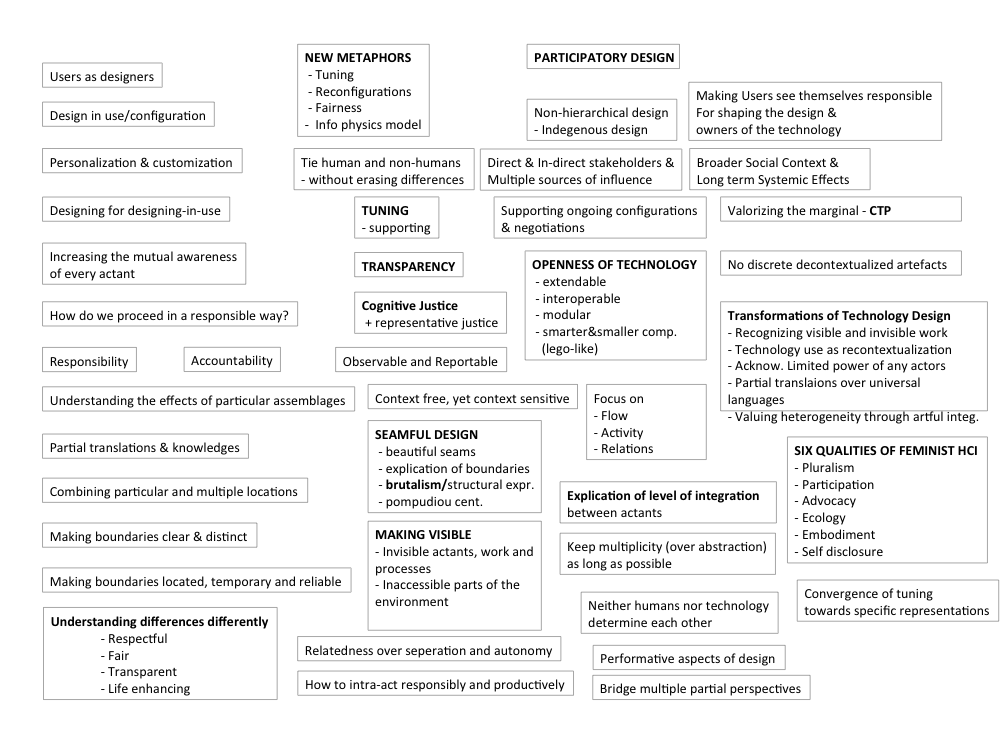
Tuesday, January 25, 2011
Mind Map
A mind map which shows many useful connections between concepts, phenomenons and approaches.


Monday, January 24, 2011
Relationality Lens / Quality
It seems that almost everything can be considered relational. Things become meaningful in relation with another thing. Thus, everything can be seen as an effect. So can agency. The important point is how much we consider this characteristics of things. How much do we consider its implications? How much do we know what a relational view of agency requires? How do we know whether our (design) practices embrace this notion of agency or not? Should we try to control it? or diminish it? or support it?
Designing for agency asks us to recognize this characteristic and support it. However, sometimes a limited or controlled level of relationality might be required, in those cases (such as high performance systems or higher reliability required systems), at least an awareness of relationality and consideration of implications of our decisions on agency are desired.
Relationality quality asks for:
i- understanding of mutual influence, shaping and co-constitution of actors and artefacts.
ii- embracing emergent and improvised action.
iii- considering system as an assemblage/network of actors, artefacts or collective hybrids.
i- what does it mean? what does it involve?
ii- how can we embrace them?
iii- what happens when we start to use the notion or metaphor of assemblage?
Designing for agency asks us to recognize this characteristic and support it. However, sometimes a limited or controlled level of relationality might be required, in those cases (such as high performance systems or higher reliability required systems), at least an awareness of relationality and consideration of implications of our decisions on agency are desired.
Relationality quality asks for:
i- understanding of mutual influence, shaping and co-constitution of actors and artefacts.
ii- embracing emergent and improvised action.
iii- considering system as an assemblage/network of actors, artefacts or collective hybrids.
i- what does it mean? what does it involve?
ii- how can we embrace them?
iii- what happens when we start to use the notion or metaphor of assemblage?
Sunday, January 23, 2011
Multiplicity Lens / Quality
From the ASD lenses document:
- flat design hierarchy
- multiplicity in representation
- constructive engagement with diversity
- participatory activities (multiple sources of influence)
- cognitive justice and valorizing marginal views
Against the accounts of neutral and deterministic accounts of technological agency. feminist technoscience approach claims that agency is not an attribute of humans alone but enacted and performed in socio-material configurations and intra-actions. This view opens up for the reconfigurations of design and use for more ethical effects such as cultivation of cognitive justice, the equal treatment and representation of different ways of knowing the world. The implication of this approach is that design becomes an adaptive and intra-active process in which more desirable [and sustainable] configurations of people and technology become possible.
Cognitive justice asserts the diversity of knowledges and the equality of knowers.
Donna Haraway:
How can we do justice to our different knowledge practices and at the same time share a common world? (Knowledge as embedded and situated) by democratization of science and technology as a requirement for the answer!
Visvanathan and Maja Van Der Velden:
Monocultures, western science view >> as the museumisation of indigenous knowledge(that means it is only useful for historical display) and scientific endeavor. Science contains its own grammar of violence that needs to be addressed. Cognitive justice is not only about participation but cognitive representation: The idea of participation fundamentally accepts the experts’ definition of knowledge … experts’ knowledge is represented as high theory and layperson’s ideas as a pot-porri of practices, local ideas and raw material. Thus democratization of science should be extended to include alternative sciences. It should be possible to validate other forms of knowledge.
The solution, he argues, lies in a political economy and cosmology based on the following principles of cognitive justice:
• All forms of knowledge are valid and should co-exist in a dialogic relationship to each other.
• Cognitive justice implies the strengthening of the 'voice' of the defeated and marginalised.
• Traditional knowledges and technologies should not be 'museumized'.
• Every citizen is a scientist. Each layperson is an expert.
• Science should help the common man/woman.
• All competing sciences should be brought together into a positive heuristic for dialogue.
In this new relationship, framed by the principle of cognitive justice, it becomes possible to validate other forms of knowledge and to validate laypersons as experts. This validation is not an automatic justification for local practices but a “positive heuristic for dialogue” and will expand the democratic notion of citizenship, from voter and consumer to the citizen as knower. A dialogue of knowledges in order to create a new or alternative conception of Science.
Haraway shows that the alternative to this strong relativist position is not the single view, as argued by Nanda, but “partial, locatable, critical knowledges” in a dialogical relationship (Haraway 1995). This relationship is guided by epistemic responsibility and critical inquiry, not by an “everything goes” position that is as equally “from nowhere” as the positivist position.
Cognitive justice is first of all a call for making other ways of knowing visible, in particular the knowledge of the defeated and marginalised. Their relative validity will be realized through their inclusion in the heuristic dialogue between (conflicting) knowledges. they should be treated equal in terms of access to and participation in dialogues of knowledges.
This inclusion should not be understood as an automatic justification for local practices but as step towards a “new global language within which you can locate a local practice, or a multiplicity of local practices.
With cognitive justice there is no objective expert position from which to design and develop technology.
In theory, a design process based on cognitive justice would lead to technologies that are more flexible, because they accommodate diverse interests, and more democratic, because they incorporate diverse values. In practice, the full participation of end users, including their diverse knowledges in each phase of the project, leads to technical solutions that provide a better overall fit. As the study of ecological systems shows, diversity plays a crucial role in a system’s ability and capacity to adapt to change and to solve problems. In the absence of diversity, development can stumble and social, economic and cultural disruption will follow (Apffel-Marglin & Marglin, 1996; Lal, 2002; Shiva, 1993).
Cognitive justice enables diversity and it is in this meeting of the knowledges of participants that effectiveness is generated.
Johnson et al. (1998) argue that a diverse, non-competitive system is more successful in problem solving than a competitive, survival-of–the-fittest system. This may be the result of diversity enabling self-organisation. Thus the diversity and self-organising capacity of a system are interlinked. Self-organisation, the process in which global order comes forth out of local interactions, builds forth on both the differences and commonalities found in the local entities that form its diversity. A self-organising system uses collaboration and decentralised local control to network the local entities.
What design principles encourage cognitive justice? Adaptive technology design that changes acc to the needs of users. Design becomes more process oriented, an ongoing dialogue between design, designers and users as designers. It also changes the perception of the lifetime of design.
- flat design hierarchy
- multiplicity in representation
- constructive engagement with diversity
- participatory activities (multiple sources of influence)
- cognitive justice and valorizing marginal views
Against the accounts of neutral and deterministic accounts of technological agency. feminist technoscience approach claims that agency is not an attribute of humans alone but enacted and performed in socio-material configurations and intra-actions. This view opens up for the reconfigurations of design and use for more ethical effects such as cultivation of cognitive justice, the equal treatment and representation of different ways of knowing the world. The implication of this approach is that design becomes an adaptive and intra-active process in which more desirable [and sustainable] configurations of people and technology become possible.
Cognitive justice asserts the diversity of knowledges and the equality of knowers.
Donna Haraway:
How can we do justice to our different knowledge practices and at the same time share a common world? (Knowledge as embedded and situated) by democratization of science and technology as a requirement for the answer!
Visvanathan and Maja Van Der Velden:
Monocultures, western science view >> as the museumisation of indigenous knowledge(that means it is only useful for historical display) and scientific endeavor. Science contains its own grammar of violence that needs to be addressed. Cognitive justice is not only about participation but cognitive representation: The idea of participation fundamentally accepts the experts’ definition of knowledge … experts’ knowledge is represented as high theory and layperson’s ideas as a pot-porri of practices, local ideas and raw material. Thus democratization of science should be extended to include alternative sciences. It should be possible to validate other forms of knowledge.
The solution, he argues, lies in a political economy and cosmology based on the following principles of cognitive justice:
• All forms of knowledge are valid and should co-exist in a dialogic relationship to each other.
• Cognitive justice implies the strengthening of the 'voice' of the defeated and marginalised.
• Traditional knowledges and technologies should not be 'museumized'.
• Every citizen is a scientist. Each layperson is an expert.
• Science should help the common man/woman.
• All competing sciences should be brought together into a positive heuristic for dialogue.
In this new relationship, framed by the principle of cognitive justice, it becomes possible to validate other forms of knowledge and to validate laypersons as experts. This validation is not an automatic justification for local practices but a “positive heuristic for dialogue” and will expand the democratic notion of citizenship, from voter and consumer to the citizen as knower. A dialogue of knowledges in order to create a new or alternative conception of Science.
Haraway shows that the alternative to this strong relativist position is not the single view, as argued by Nanda, but “partial, locatable, critical knowledges” in a dialogical relationship (Haraway 1995). This relationship is guided by epistemic responsibility and critical inquiry, not by an “everything goes” position that is as equally “from nowhere” as the positivist position.
Cognitive justice is first of all a call for making other ways of knowing visible, in particular the knowledge of the defeated and marginalised. Their relative validity will be realized through their inclusion in the heuristic dialogue between (conflicting) knowledges. they should be treated equal in terms of access to and participation in dialogues of knowledges.
This inclusion should not be understood as an automatic justification for local practices but as step towards a “new global language within which you can locate a local practice, or a multiplicity of local practices.
With cognitive justice there is no objective expert position from which to design and develop technology.
In theory, a design process based on cognitive justice would lead to technologies that are more flexible, because they accommodate diverse interests, and more democratic, because they incorporate diverse values. In practice, the full participation of end users, including their diverse knowledges in each phase of the project, leads to technical solutions that provide a better overall fit. As the study of ecological systems shows, diversity plays a crucial role in a system’s ability and capacity to adapt to change and to solve problems. In the absence of diversity, development can stumble and social, economic and cultural disruption will follow (Apffel-Marglin & Marglin, 1996; Lal, 2002; Shiva, 1993).
Cognitive justice enables diversity and it is in this meeting of the knowledges of participants that effectiveness is generated.
Johnson et al. (1998) argue that a diverse, non-competitive system is more successful in problem solving than a competitive, survival-of–the-fittest system. This may be the result of diversity enabling self-organisation. Thus the diversity and self-organising capacity of a system are interlinked. Self-organisation, the process in which global order comes forth out of local interactions, builds forth on both the differences and commonalities found in the local entities that form its diversity. A self-organising system uses collaboration and decentralised local control to network the local entities.
What design principles encourage cognitive justice? Adaptive technology design that changes acc to the needs of users. Design becomes more process oriented, an ongoing dialogue between design, designers and users as designers. It also changes the perception of the lifetime of design.
- Flat Design hierarchy: no expert privileges.
- Multiplicity in representation: diversity and participation. also participation of artefacts. participation of artefacts can mean different things in production and use phases. for instance, in a participatory workshop, any material used or engaged can influence the design process differently. consideration of these different materialities and their effects on perception and construction of design problem and solution space. Although we usually quite conscious about our selection and design of participatory activities and artefacts involved in those activities. We need to further think bout our choices and consider what kind of perceptions and actions are inhibited while we encourage some particular kinds. (are there any examples considering effects of different materialities?? if there exists some, how to find them?)
- Cognitive Justice: The concept of cognitive justice is based on the recognition of the plurality of knowledge and expresses the right of the different forms of knowledge to co-exist. Co-exist in design and use. involving different users with different backgrounds who will be part of the future assemblage/the system. if possible some indirect stakeholders who are likely to be affected by use or non-use of the system.
- valorizing marginal views or assumptions: it is strategy of Critical Technical Practice and Reflective Design as well.
Visibility and Accessibility Lens/Quality
Visibility is probably the most important quality for supporting agency. if actants can see or perceive the environment and other actants in it (related to his interests), this brings a possibility of creating a connection between perceiving and perceived actants. This connection is the starting point of relational agency. By means of making visible all the actants in a design case, we can facilitate the emergence of different forms of agency (each temporary assemblage with different configurations may lead to a different capacity and series of effects and we can consider them different forms of agency). it is directly related with increasing the awareness of one actant towards self, others and environment. if an actant has awareness, it can get connected.
- One fundamental question: what does making visible mean? so there should be someone who "makes" things which are apparently hidden or invisible, and in need of more attention or in need of being recognized. does it mean that the thing becomes perceivable by others. does this guarantee that it is going to be recognized? not necessarily, but this process may help it to become one of the matters of concerns.
- What to make visible? actants, artefacts, processes, roles, infrastructure (any contextual element. however, too much visibility might create confusion and may invade privacy, it should be carefully managed. for instance, peripheral or ambient awareness/visibility might be a suitable way. )
- when to make visible? visibility in production phase (for cognitive justice(initial step, more needed), for recognition of roles and contributions and for explicating possibilities of new couplings or assemblages ) and visibility in use phase (more control and care are needed for preserving privacy, but explicit interaction at some degree can still be beneficial for accountability and emergent, improvised and collective action)
- how to make visible? focus/nimbus model?? participatory design techniques, awareness literature. public availability of resources. e.g. co(a)gents- stuvidpi... To Be Investigated.
Questions and Answers:
- What to make visible? actants, artefacts, processes, roles, infrastructure (any contextual element. however, too much visibility might create confusion and may invade privacy, it should be carefully managed. for instance, peripheral or ambient awareness/visibility might be a suitable way. )
- when to make visible? visibility in production phase (for cognitive justice(initial step, more needed), for recognition of roles and contributions and for explicating possibilities of new couplings or assemblages ) and visibility in use phase (more control and care are needed for preserving privacy, but explicit interaction at some degree can still be beneficial for accountability and emergent, improvised and collective action)
- how to make visible? focus/nimbus model?? participatory design techniques, awareness literature. public availability of resources. e.g. co(a)gents- stuvidpi... To Be Investigated.
Subscribe to:
Posts (Atom)